Speech by Mike Eldon at the Strathmore University Business School Annual Executive Education Programmes Graduation on 1st December 2023
Click here to download the full speach (PDF, new window)

Speech by Mike Eldon at the Strathmore University Business School Annual Executive Education Programmes Graduation on 1st December 2023
Click here to download the full speach (PDF, new window)
A while ago, I facilitated a session with the board of a major Kenyan organisation, where I had them reflect on what they were proud of as a board and as individuals, and what additional aspects they wished to be proud of later.
The team is undergoing a review of its culture so as to take it to the next level, and as the directors reflected on the initiative they felt they could and should be more involved.
This is very much the norm at the director level. They are typically far more concerned about the numbers, the financials, which is what led the two Harvard professors, Kaplan and Norton, to come up with their Balanced Scorecard.
Through this framework they had company leaders place equal emphasis on the factors that deliver the numbers: the products and customers; the systems and processes; and the people – the element they described as “learning and growth”.
It is of course the people who define and live the culture, perceived through how they behave, which reflects their attitudes, these being a function of their values.
How many directors feel competent, and hence confident and comfortable dealing with such soft issues? Not many. “Leave it to the HR people,” they may well say, as they return to their easy-to-measure revenues, profits and suchlike.
I have written before in this column that few people at any level possess the expertise needed to enhance a culture.
At best they may find ways of defining the existing one, with all its ups and downs, and of sketching out the aspirational one, with the usual words to describe it: trust and openness, innovation and collaboration….
But as for how to migrate to that better world and overcome present challenges, don’t ask them. Indeed some will tell you it’s a waste of time, as most culture-change programmes fail to make a difference.
Then, as I read what others write on this subject – not least at the national level – too often I again see descriptions of how awful the present culture is or how wonderful living Utopian values would be, calling for a transformation to that ideal world but without in any way guiding us on how to travel along the journey towards it.
Yet while it is true that many culture-change initiatives fall way short of what they were intended to achieve, some do deliver both significant and sustained impact. What differentiates the two?
First, it’s investing time in bringing people together for open conversations that generate what I call “purposeful reflection”, where participants discuss and agree on what they will do more of and less of, start doing, stop doing and continue doing.
This requires the presence of a safe space, or as it is now sometimes described, one of “psychological safety” – which, allow me to state, is more readily created by external facilitators skilled in creating such a space and conducting such activities.
Without going into other critical success factors for culture change, let me jump straight to the need for enthusiastic support from the board.
Everyone must know that at the top level, it is accepted that culture does indeed eat strategy for breakfast – or, as I put it, that there must be a culture strategy component within the overall strategy.
The directors must be part of the strategy development and then participate in the conversations about culture, adding value to them and being role models for the desired culture.
They must also appreciate that changing a culture is much more than a one-off event but a continuous journey, one that requires focus and time, plus the relevant specialised skills and experience among those driving it.
And the performance management system must be such that those who embrace the desired culture are recognised and rewarded – which is why “Change Champions” are often identified as part of the process.
These days it is expected that directors undergo training, and this is now indeed the norm. But beyond programmes that relate to governance issues of oversight, compliance and risk management, how many cover the softer areas of leadership, like culture?
Happily, the organisation that invited me to spend time with their board appreciated this need, and I am confident that their directors will now ensure that matters to do with culture remain firmly on their radar.
I was recently invited by professional advisory firm Ronalds East Africa to be one of the keynote speakers at their training event for Chief Finance Officers (CFOs) and other leaders of the finance function. My session was about advising the participants on how to interact effectively at the board level.
There was quite a spectrum in the room, from senior finance folk who regularly attended board and board committee meetings, to younger, more junior ones. Some of the CFOs were executive directors on their boards, with a regular seat at the top table, while others were only invited to contribute on specific items.
I asked them if they held responsibilities beyond financial management, and one lady told me she was the finance and administration manager – a not uncommon combination. (To me “administration” has always sounded rather old-fashioned and bureaucratic, and I suggested they think of a more contemporary term).
Elsewhere I have seen CFOs also oversee functions such as strategy and performance, risk and compliance, investments, mergers and acquisitions, and ICT. For obvious reasons, those whose portfolios are broadest are the ones most likely to climb further up the managerial ladder, I emphasised.
In my session I asked a series of questions, first about their alignment with the CEO. Did they work together as a close team, with mutual trust and respect? And then about management’s relationship with the board – individually and as a team. “Do you look forward to engaging with your directors, or do you dread the interactions?” I posed, before also asking if the directors looked forward to engaging with them.
Not very positive responses here, accompanied by several statements admitting that they only speak if asked to do so.
So, what holds them back? Why do so many CFOs underperform when they appear in the boardroom? My first point was that too many heads of departments, including CFOs, feel intimidated when in the presence of directors, and these feelings are reflected in their behaviour. It’s why they keep their contributions as short as possible, they don’t project their voice, and avoid eye-contact.
Others, however, are over-confident, perhaps being expert at spouting the numbers, despite lacking either the holistic organisational perspective or communication skills. They are inadequately prepared, not having translated their overcrowded spreadsheets into easy-to-absorb graphics; not having been coached in how to communicate for this level of engagement; and not having been through rehearsals to the meetings.
My next slide asked “Are you just Dr No?” Here I had them probe the extent to which the image they felt they should portray had them play too much of a stern-parent role, exception-reporting on the over-spenders and the under-deliverers… while remaining silent when the numbers looked good. Alongside this, many of their tribe enjoy being the most risk-averse in the room, displaying consistent worst-case pessimism and merely focusing on why any new initiative will not succeed, and in any case is unaffordable.
“Are you just book-balancers, number-crunchers, cost-minimisers?” I asked provocatively. “Or do you also see yourselves as advisers, consultants and coaches to your colleagues – including directors?” And how good were they at managing relationships, I inquired, whether internally with other functions, departments and locations, and between levels; or externally with investors, bankers, auditors and others?
To help them here I delved into my favourite topic of emotional intelligence, explaining how those with high EQ interact in ways that result in win-win outcomes, where everyone feels adequately satisfied and so owns the plans and commit to their implementation.
Whether in their technical financial skills or their non-technical skills of 360-degree relationship building, they need not only to be competent, I stated, but to match that with a healthy mix of confidence and humility, making others feel comfortable when interacting with them.
It is by expanding their comfort zone through developing new and broader skills that their circle of influence would expand. Their constructive, helpful voice will be listened to more, and those around them will see their potential for both higher cross-functional and boardroom responsibilities.
Around the world organisations are downsizing, whether because of the generally tough economic times or for other reasons. And as we observe how this is being handled we see a whole spectrum of employer behaviour, from the brutal to the caring.
Some have simply sent texts to staff, informing them that they are being laid off. How cruel that is! No wonder, as I wrote in an earlier article, leaders like Jack Welch felt one of the most important and challenging skills for managers to develop is holding difficult conversations, such as ones to do with downsizing inevitably are.
The task of those who must inform staff members that they have been laid off is incredibly difficult, admitted Welch.
They feel guilt and anxiety before, during and after. And he was surprised that he couldn’t identify any programmes that helped people develop the skills needed to conduct such meetings.
I decided to write this column as I was recently exposed to a manufacturing company that needed to downsize its staff and made the hard decision to do so.
Despite the difficult financial situation in which it found itself, the board and management were clear that they would provide those leaving with as soft a landing as possible.
Their approach was to offer voluntary early retirement to staff, with reasonable benefits beyond the payment of their notice period, in the hope that no one would have to be asked to leave against their wishes.
A considerable number applied, including a few senior staff who’d been with the company for many years – which gave an opportunity to younger employees to inherit their responsibilities.
Those leaving were offered training sessions that prepared them for seeking new opportunities, and as Welch recommended, they were encouraged to believe that there was a better life ahead of them, aligned with their interests and aptitudes.
As I wrote in another of my articles, about directors reaching the end of their terms, when people retire they go through a grieving process, with the usual steps of denial followed by acceptance, mourning and eventual healing.
I was referring to a different kind of situation, but my point there is valid here too, finding ways of helping the leavers to deal with their loss, while those remaining make their exit much smoother and more graceful than many turn out to be.
The advice I gave to the retiring directors was to accept that their positions were never meant to be for life, and that as one door closes others may open. Keep giving your utmost till the last day of your term, I insisted, and hand over on the due day with no regrets.
Your inner motivation and sense of commitment may have dimmed somewhat, but let this in no way affect how you perform your duties. Be proud of your legacy, and have others speak well of you.
As for those remaining, they should understand that their departing colleagues are likely to be indeed grieving, however stoic they may appear. Therefore, show generous appreciation for where and how they have made a difference.
We are all in need of empathy and appreciation, so say farewell nicely, and have them continue to speak well of the place they are about to leave.
Farewell lunch
The organisation that I witnessed going through downsizing hosted a farewell lunch for the retirees, giving them an honourable send-off. The CEO invited each of the newly promoted team members – also present – to say a few words, before asking those who were leaving to speak. Without exception, everyone was positive and appreciative of their time with the company, whether it had come to an end or not.
And the retirees were also exceptionlessly optimistic about the company’s future, saying they were leaving it in safe hands to deal with the present challenges.
Several of the leavers stated that they could always be called upon for support and one, with a light touch, suggested if their younger replacements came across a problem they could blame him!
Several directors were also present, and when they spoke some expressed how moved and encouraged they felt, saying they would miss those who were leaving.
The retirees were wished well in the next stage of their lives, and the “youngsters” who were taking over were assured that they had the full support of the board.
My strong sense was that here the grieving was much milder than usual. Indeed the whole spirit was an uplifting one. So if you are having to downsize, do also behave humanely with those who will be leaving.
I am sharing with you a conversation I had with three young women leaders, launched by one of them about a situation in which she found herself. “I am the only woman on this board, and one of the men asked me to get him a cup of tea,” she narrated and asked how I would have reacted.
Earlier I had shown myself to be a champion for women, so she was surprised and dismayed when I replied that I would have brought him the tea. I explained that otherwise I would have risked provoking resentment on his part, and hence quite likely jeopardised our relationship.
My suggestion was that she should be building her status as a board member by making high-quality contributions, leading people like him to perhaps think again about such requests.
However, I would not have left the matter there. I hoped her chairman — or another director — was someone she could have approached after the meeting, requesting him to speak to his fellow board member and suggest he find other ways of getting his tea.
She revealed that she had indeed refused to be the “tea-girl”, and quite assertively so, but it turned out that at the subsequent board meeting and consistently thereafter other staff provided the service.
She wasn’t aware of how this came about, but she was relieved that she no longer risked being placed in this awkward situation.
Others in our group now had their say, with one suggesting she would have just put the tea on the table without actually serving the man, and another saying she would have smiled as she responded, whether accepting or refusing his request.
I now had two of the women role-play the situation, with one acting the part of the man. How did he feel when his request was strongly rejected? Was he embarrassed and remorseful? Did he resent the snub? It’s good to put oneself in the other’s shoes.
As we continued, I decided to call my wife, who has over the years often been the only woman on a board. Had she ever been asked to be the tea-girl? And if so how did she handle the situation? No, she hadn’t, she told me, but if asked she would have done so – with a smile and a light touch.
I then brought the conversation to the subject of emotional intelligence, which I suggested is about negotiating win-win outcomes. The challenge here was how to deal with the tea request in a way that both parties ended up feeling OK about it all.
And for me that meant giving way at the outset, while finding gentle ways of preventing a recurrence. Not necessarily by engaging directly with the other person, but perhaps seeking the intervention of a third party, a mediator.
One aspect of emotional intelligence is that sometimes we need to find the strength to separate how we feel from how we behave.
For sure, the lady board member resented being asked to be the tea-girl. But my thought was for her to swallow her short-term pride to allow for an easier long-term resolution.
Here we were talking about a small matter, however demeaned the lady in question felt. But the pluses and minuses of the different approaches we discussed among us regarding the tea-serving apply much more broadly. And not just between men and women.
It can be between older and younger people, senior and junior ones, the more and the less educated, and other pairings where one side feels unduly entitled to favours.
A final word on women’s empowerment. Any time I hear about women “fighting” for their rights it worries me. For in fights there are winners and losers.
Where such aggressive women win their fight, one of their key measures is that men will lose. No, I say. I am an absolute supporter of women’s rights, but wherever possible to go after them in graceful, elegant ways that allow for win-win all round.
Going back to the days of the British suffragettes who struggled to obtain the right to vote for women in the early 20th century there were two groups: one that was confrontational and dramatic, and one that operated more quietly but at least as effectively. I would have been with the latter.
So to the women reading this I say, smile rather than frown as you advocate for your cause. And to the men, go get your own tea.
I have recently been exposed to a couple of situations where the manager of a salesperson has been playing an unnecessarily high proportion of the role that could and should have been carried out by the salesperson. In each case, the salesperson was an “account manager”, or “relationship manager”, two terms which I like and to which I relate closely, as when I started my career in IT vendoring in the late 1960s this was my position, one from which I learned so much.
In these recent situations, I was acting as a coach to both the managers and the salespersons, helping them migrate to a situation where the managers could leave much more of the customer engagement to their subordinates, allowing them to deal with more strategic issues.
I suggested launching the process by preparing for meetings with customers where this would happen, and agreeing on how each would contribute to the flow.
It helps to rehearse, to role-play, with the two acting as themselves and someone else playing the part of the customer who’s been used to dealing with “the big man”. So we did.
Needless to say, this assumes the account manager is actually fit for purpose, particularly in dealing with people at a higher level than theirs, for if not their skills must be developed through training, coaching and other exposures.
In my recent examples, the relationship managers were indeed capable of engaging effectively with more senior people in customer environments, possessing the necessary combination of competence and confidence to fulfil both the technical and non-technical aspects of their work.
Too often, however, the more junior person lacks the confidence to deal with more senior customer representatives.
In my first ever sales training course I was introduced to the notion of “the nodding manager”, who as much as possible merely listens to their subordinates interacting with customers, with a supportive body language that shows their endorsement of what they are hearing.
So, as the meeting progresses, the manager says less and less and their junior ups their contributions and hence their credibility and acceptance. One must surely study the behaviour of the customer, to assess their readiness to be “degraded” in this way.
For in one of my recent situations, the senior customer person who’d been used to dealing with a manager had to be nudged to have their counterpart in the vendor organisation now be at a lower level.
Where their ego had assumed they’d be dealt with by their counterpart, they were now being asked to be humble enough to agree to the downward switch.
For me as a customer that wouldn’t be a problem, as it seems obvious that everything should happen at the lowest possible level. If the more junior person in the hierarchy is fit for the job, that’s all that matters.
Provided that between them and me as their customer we know where an issue is beyond their pay scale and we need to escalate higher office.
That’s an important point for relationship managers. As I wrote in an earlier article, where a matter needs escalation, whether within their own organisation or in the customer’s, they must develop the skill to know when and how to do so.
It should neither be too soon nor too late, and it should be pursued with emotional intelligence so that no one is offended. Escalation management is as important a skill as delegation management.
When all those years ago I was an account manager, I was allocated a small number of large customers where I was the one coordinating the software and hardware technical people supporting them, as well as the finance folk.
What a learning-by-doing experience this was, where I had to motivate and coordinate those involved on my side and help them not only to perform the technical aspects of their work effectively but also to communicate well with the customer staff.
And despite having these responsibilities I was not their line manager, having no direct authority over them – just influence.
My sense is that most account/relationship managers receive inadequate preparation for dealing at multiple levels with their customers.
They are insufficiently equipped for either handling problems that arise or proactively initiating new sales.
Last Friday, immediately before this week’s Africa Climate Summit, KENCTAD (the Kenyan Entrepreneurs’ Conference on Trade & Development) organised a conference on sustainability.
It was all to do with how being serious about ESG (Environment, Social and Governance) issues benefits businesses, and I was invited by Ngida Sebastian, KENCTAD’s ESG Lead, to be the keynote speaker.
For a whole day, we heard about the seriousness with which so many organisations in Kenya take ESG, and it was fascinating for me to listen to this collection of good people talking about how they took these subjects seriously and expected to do well as a result.
For my talk, from observing other ESG stalwarts with whom I have been interacting, I had already thought about what such organisations have in common, and this was further reinforced as I listened to the day’s other speakers.
The most fundamental characteristic is that the leaders of these entities live all the uplifting values that most others at best just talk about.
To sum it up, they are responsible members of society, whether relating to the environment, to social issues or to how they govern themselves. They are fair to all key stakeholders and treat others as they wish to be treated.
A direct consequence of living such values is that they say “No” when they should, and hold back from sub-optimising to the short-term.
A good example of this in the area of CSR(Corporate Social Responsibility). In my talk, I referred to Prof Michael Hopkins, from whom I learned that CSR should be so much more than a project, or even a programme, but a whole mindset of being responsible – and in support of sustainability.
Its ultimate impact should be that the beneficiaries of your CSR reach places of dignity and self-reliance – ideally to the extent that they in turn are able to offer CSR to others.
One of the questions posed to me during my session was about the difference between CSR and CSI (Corporate Social Investment).
I like that CSI term as it implies the existence of a return on the investment, one that is measurable and impactful.
And it speaks to a longer-term consequence of being responsible, beyond immediate short-term benefits.
As I wrote in my recent article on trust if we are to develop a more trustworthy – a more responsible – society, we must gather a critical mass of trustworthy people and institutions.
This I reiterated at the conference, and it was beautifully spelt out by two other speakers.
Peter Wairegi, the Chair and CEO of KPRA, (Kenya Professional Realtors Association), told us how they drew together the good guys in his sector, introducing standards, offering training and generally raising the performance bar.
And Akshay Shah, the Chair of KEPRO, (Kenya Extended Producer Responsibility Organisation), spoke equally inspiringly about how this Business Member Organisation works on accelerating the growth of Kenya’s recycling ecosystem, leading to a Circular Economy that will protect our natural environment and creating jobs for future generations.
As with KPRA, they collaborate with the relevant government bodies to bring in regulations and build the capacity to behave responsibly: “sticks and carrots” as he put it.
There were so many other uplifting stories, including from Maryann Nderu, EABL’s Sustainability Manager, about their promotion of “positive drinking” and of women in leadership; Edna Kimenju, Deloitte’s ESG Manager, about how they advise on bringing about sustainability; Rufus Mwenda, a member of the ABSA sustainability team; and Noreen Nthiga, an organisation development and policy specialist in the Office of the President, on supporting SMEs in these areas.
If I had more space I would add several others. But let me conclude by noting that in Kenya today we have an amazing number of responsible people who are running responsible organisations.
They are both visionary and practical in how they approach ESG; they keep things simple and transparent and expect to make a positive difference to the society in which they operate.
They also prove that it is not only a nice thing to do but that it works commercially, not least for their long-term sustainability.
Increasingly these days, if we are to attract good people to work for us, good customers and good suppliers, good financiers and insurers, we’d better get as serious about ESG as those who spoke at and attended the KENCTAD conference on sustainability. I’m so glad I was there to absorb their positivity.
I’ve written before about Frank Kretzschmar and my Leaders Circle events, and here’s something about the most recent one we hosted on the story-telling theme “Gaining and losing trust: moments of judgment, and their consequences”.
In preparing for the event I dove into the three books on trust by Stephen M.R. Covey (the son of the Seven Habits Covey).
His first one, The Speed of Trust, which appeared in 2006, spelt out the benefits of trust so well: where trust is present, everything speeds up and costs reduce.
Then, in his 2012 Smart Trust, he went further, suggesting that high trust also delivers prosperity, energy and joy.
And in his 2022 Trust and Inspire, all about high-trust leaders, he contrasted them to the untrusting command-and-control ones, seeing that trusting leaders attract and retain great talent, that’s bold, engaged and innovative.
Covey certainly doesn’t believe in blind trust or naïveté. Equally though, suspicious or cynical mindsets do not appeal to him.
President Reagan’s “trust but verify” seems a plausible middle road to travel, along with applying appropriate controls.
The World Values Survey, which asks citizens about their beliefs, opinions and activities, has consistently found that compared to many societies in Africa, Kenyans are less likely to trust people they don’t know, and also those they do know.
Further, domestic opinion polls regularly find that a majority of Kenyans lack trust in the country’s most important government institutions.
Having said that though, there are many trustworthy Kenyans – including in the public sector. And there are many trustworthy Kenyan organisations, whose people say “No” when they should.
We asked the participants to tell us how they act when they have lost trust in others – or others have in them – knowing that, as the African proverb tells us, “one lie spoils a thousand truths”.
We heard about the NCIC report on our elections, where they found the top roadblock to a peaceful one is a lack of trust between ethnic groups and in our institutions.
Just like now, where the government and the opposition clearly do not trust each other.
One participant lamented that “trusted people are a dying breed’. Another challenged him that even in government there are still many trustworthy people.
On the positive side, I referred to Equity Bank’s release that day of its Sustainability Report, titled Growing Together in Trust.
We heard about the increase in trust here thanks to digitisation, like with the iTax system, but concern was expressed that our media only report on what the bad guys are up to, unduly influencing us to reflect such cynical negativity.
“Life is so complicated that it is impossible not to be a hypocrite,” one stated. He put himself in the shoes of low- or no-income people who are forced to steal or seek bribes to keep going.
The leader of an insurance company confirmed that trust is everything there – not least in dealing with claims.
Yes, you must trust your clients enough, but you must apply checks and balances through conditions and controls.
And if you reject a claim you must be trusted that your reasons were solid. Basically, unless you trust one another there can be no relationships.
Then we heard that if you are trustworthy it takes a long time to reap the reward.
In conclusion, I suggested that we must gather a critical mass of trustworthy people and institutions as this is what will move the needle towards the positive end of the trust spectrum.
“Human progress isn’t possible without trust,” asserted one, while another talked about the presence of inner peace when we interact with someone we trust.
Last December I wrote in this column about the importance of adopting a systems approach to corporate social responsibility, aligning and integrating it not only with the Sustainable Development Goals and ESG (Environmental, Social and Governance) issues but also with the overall organisational strategy. (This is despite concerns that neither the SDGs nor ESG incorporate a systems approach!)
More recently, I facilitated a workshop for the African Population and Health Research Centre (APHRC) that wished to identify the linkages between the objectives in the five-year strategic plan it developed.
Good for them, as this systems-thinking approach is such a minority sport among strategy developers. Yes, they identify key objectives, along with the performance indicators, the who’s-got-to-do-what-by-when, the budgets, the risks and so on, but it’s rare that they worry about cause-and-effect relationships between the objectives.
APHRC is one of the few that apply a systems approach to how they operate. During our workshop, they identified linkages like those that will create more synergy between research teams; ensure deeper collaboration between their researchers and their advocacy and communications people; and accelerate the development of multi-disciplinary talents – within individuals and collectively.
The framework adopted for their plan was the Balanced Scorecard, first with the linkages between its four standard pillars of products, services and customers; our people; systems and processes; and financial sustainability.
The whole reason for the development of the Balanced Scorecard was to show how the “lead” factors in the first three pillars impact each other and the consequential “lag” factor in the fourth pillar, the financial one.Equally evident is that unless funds are available to invest in the lead factors nothing will happen. And so on.
Similar cause-and-effect relationships exist between individual objectives within and between the pillars, and the way to identify these is by developing a “strategy map”, a hierarchy of how objectives impact one another.
So, we placed financial sustainability at the base, with products and customers at the top and the other two in between.
Then alongside each of the four-pillar headings, the team placed the objective statements that had been identified within them.
Now the fun began: they drew arrows to map out the relationships between objectives. Then, whenever I and my colleagues lead this exercise we are amazed not only by the number of arrows that are drawn but also by the variety of directions of the arrows – sometimes both ways, as I mentioned above.
The consequences of defining these linkages are profound. For they show where collaboration must take place, and why silos are counter-productive.
Having representatives from all parts of APHRC in the room participate in the development of the strategy map was vital, as then everyone understood how and why these linkages are important. They own the linkages they authored, and are motivated to work together.
Collaboration becomes the norm, the culture of the organisation, “the way we do things around here”. Involving external key stakeholders is also important.
The spirit of collaboration is also embedded as a key element in APHRC’s performance management system, from the overall through to the individual level.
It is this mindset that is identified as systems thinking, ensuring that everyone’s on the same page – the opposite of those blindfolded folk around the elephant, each describing the part of the animal that they are touching.
Where this leaves the organisation’s leadership also becomes clear. They must be like orchestral conductors, bringing their players together as they help each section of the orchestra, each member, to contribute to the harmonious whole.
No gaps or clashes, with musical conversations between the players that appeal to the ear.
To help us appreciate the power of systems thinking is to appreciate how the brain relies on endless linkages between the cells to help us to navigate and to learn and adapt.
Are there elements that suffer as unsupported “orphans”? Are there under-used and uncoordinated enablers? Link, link, link.
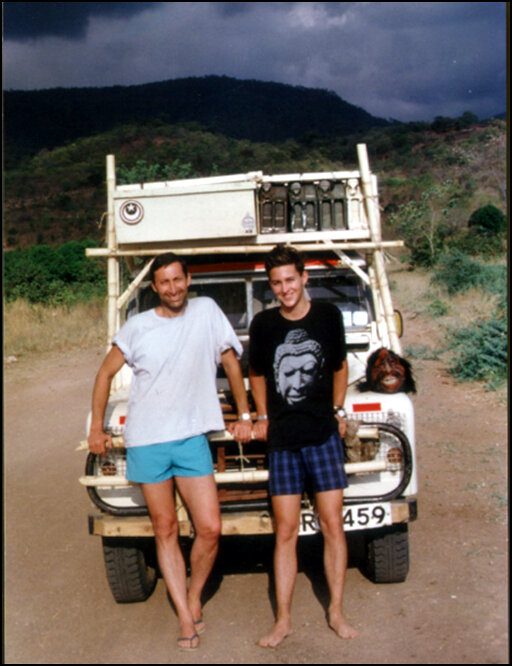
Dan and me in front of his Land Rover in Malawi, 1989
Tomorrow it will be 30 years since my son Dan was killed in Somalia at the age of 22. Dan was a Reuters photojournalist there and he, along with Hos Maina, Anthony Macharia and Hansi Kraus, was attacked with sticks and stones by an angry mob infuriated by the bombing from an American helicopter of a house in Mogadishu where a number of Somali leaders were meeting.
Yes, we knew Dan was operating in dangerous territory, but just as he was confident of his ability to thrive there, we too were hopeful that he would come to no harm.
He was having the time of his life, not only seeing his photos featured prominently in leading global newspapers and magazines — including a double-page spread in Newsweek — but also enjoying selling his T-shirts and postcards, and later a whole book of his photos to diplomats, American soldiers and others.
Dan also ventured into parts of Mogadishu where no one else dared go, including having fun with children, earning the nickname “The Mayor of Mogadishu”.
Dan was one of the media people on the beach who witnessed the cautious landing of the American troops, which became a source of ridicule.
Then, suddenly, this wonderful young man was gone. Who knows how his life would have unfolded had he remained with us?
What would he be up to now in his early 50s? I sometimes idly speculate about that, but mainly I keep focused on how he had been living and hardly on the tragic circumstances of his death.
These days it is not uncommon for funerals to be the “celebration of life” of the person who passed away, and this is how we remembered Dan at his service – which we held at Corner Baridi behind the Ngong Hills, on the land of the Maasai family whom Dan had been helping.
From then I have continued celebrating my son’s life, and the great influence he has had on me — and others — through his vibrant and positive inspiration.
After Dan died, I sought a way to immortalise the essence of Dan by developing the character of young people — something both he and I were active in our own ways.
What emerged was The Dan Eldon Place Of Tomorrow, The DEPOT, which we launched in 1994 as a centre for outdoor experiential learning for youth and evolved into broader management consulting.
Our ethos at The DEPOT reflects how Dan expected his life to unfold and also how I live mine. It is to “have a good time doing good things”, and looking back on our years together I know we reinforced each other in this regard.
There are two thoughts I, therefore, wish to leave you with. The first is that when a close relative passes away, yes it is a time to grieve, to feel sad about the loss of a wonderful person whom you loved dearly.
After my son was killed in Mogadishu, my mind naturally brooded on what happened then — and not least on the American helicopter that I learned hovered above the scene where he was being beaten to death and only landed to pick up his body.
But it turned out that I found it possible to instruct myself to switch away from all that and to focus on his wonderful life rather than on his awful death: on his delightful sense of humour, his artistic talent, his great sense of curiosity and adventure, his spirit of helping others.
From time to time when I talk with someone who has recently lost a close relative, I encourage them to write about the person, perhaps including through poetry, to celebrate their life and the relationship they enjoyed with them.
But also so the memories of the person and what they shared with them can be preserved. And finally, to act as therapy.
My second thought is to encourage all to assume that having a good time is absolutely compatible with doing good things.
Too many believe that doing good things in one’s work, important things, cannot be with a light touch. Not true, as Dan and I have found.
On the contrary, if you are enjoying what you are doing, and helping others to do so, much better outcomes will prevail.
All of us lose loved ones, and at whatever age they pass away we grieve. But pause to also celebrate their lives, and to reflect on how they have uplifted you.

